Article
Selma-Dallas County Public Library Hosts Jawana Jackson for Monthly Luncheon Series
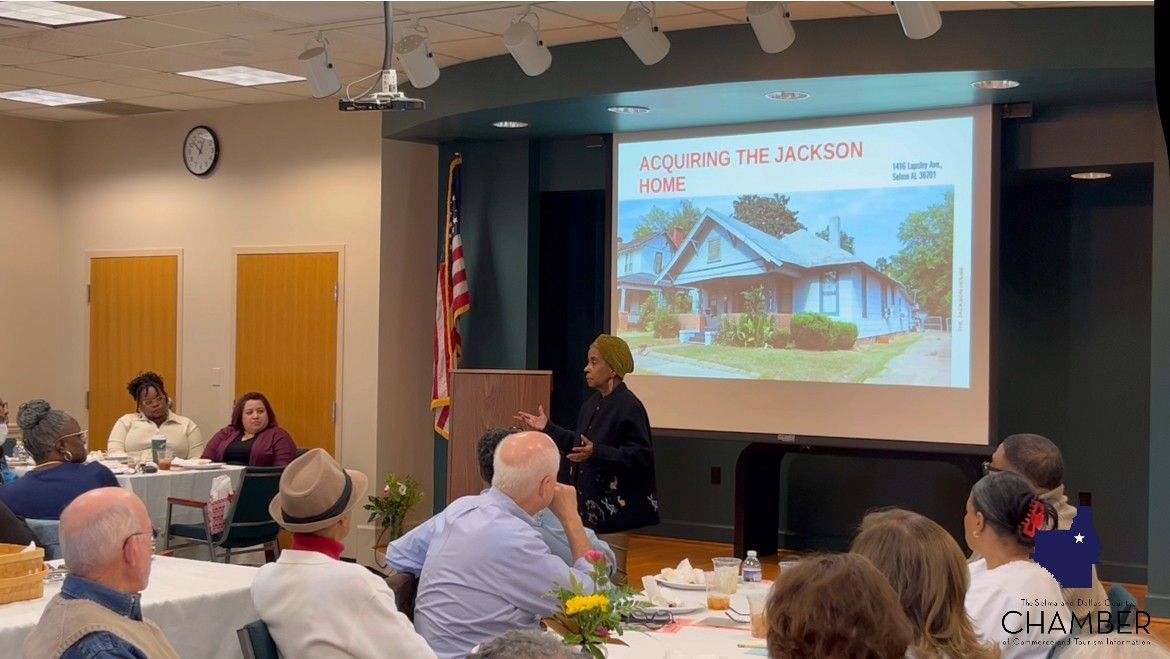
Jawana Jackson stood before the crowd in the community room of the Selma-Dallas County Public Library and shared the story of her childhood home in Selma, where her parents, Dr. Sullivan and Richie Jean Sherrod Jackson, lived many years ago. | Selma and Dallas County Chamber of Commerce and Tourism Information
By Faith Callens
Special to the Selma and Dallas County Chamber of Commerce and Tourism Information
On Thursday, the Selma- Dallas County Public Library welcomed Selma native Jawana Jackson home. Not only did Jackson return home, but she also brought with her the memories, the legacy, and the story of her childhood home in Selma where her parents, Dr. Sullivan and Richie Jean Sherrod Jackson, once lived.
During the luncheon, Library director Becky Nichols started the event off with a prayer which led to the introduction of Amber Mitchell, Founding Curator of Black History at The Henry Ford Museum of American Innovation and Heather Bruegl, Curator of Political and Civic Engagement at The Henry Ford Museum of American Innovation as well.
“They are the curators of the museum where the [Jackson] House is currently residing,” Nichols said. “I laughed and I said, “What is it like to curate a house? Catalogue a house?” “They have gotten quite the challenge, and I want to thank them for the slideshow today that gives you, kind of an idea of how this amazing journey has taken place.”
Nichols also recognized several community leaders during the luncheon such as Selma Mayor Johnny Moss, III, Dallas County Probate Judge Jimmy Nunn, Representative for U.S. Congresswoman Terri Sewell Byron Evans, and the Selma and Dallas County Chamber of Commerce and Tourism Information Director Sheryl Smedley.
There were also several others recognized at the event including members of the Selma City Council.
As Jackson came up to the front of the library’s community room, she was welcomed with a big hug from Nichols and a round of applause from a room full of community members that calls the city of Selma their home.
“I want to thank each and every one of you for coming,” Jackson said. “To my better half, James Richie, who has been with me on this journey, every step of the way; to the library; Becky Nichols, who is a wonderful, wonderful friend of my mother’s and my family; and to the Henry Ford Museum, who are now the stewards of the Jackson home— if the walls of that house could talk, what would they say?”
Jackson said the house would tell a story— a journey of a family here in Selma, Alabama that was rooted and committed to love, peace, justice and community. It also includes the story of several organizational clubs in Selma that impacted her upbringing, like the Chesterfield Club that was established in the city over 90 years ago.
“Making sure I made it to school on time,” Jackson said. “Everything that we know is community, right here in Selma. My family actually goes back to the late 1800s and matter fact, I just left— before I came here—the other family home, the Burwell home, which is right around the corner. I could never leave Selma, never ever.”
Jackson went on to talk about the Burwell home that was built in 1897 by Dr. Lincoln Laconia Burwell.
“You had Dr. Burwell, Dr. R.B. Hudson, who were brother-in- laws by the way and they married my great-grandfather’s sisters both, so a foundation was laid for my parents to open their home to Dr. Martin Luther King Jr. many, many years later.”
Jackson went on to answer the question, “Why Selma?”
“Well, we sit on a major waterway,” Jackson said. “We sit in the Blackbelt, which I don’t know how many of you realize but at one point in history of this country, the Blackbelt was the largest economic engine in America. So, during those years, you had a Dr. L.L. Burwell, a R.B. Hudson and a P.L. Lindsey and all of these people that came together to talk about education, economic sustainability and how to create and maintain community. Then, one day you had a Sullivan and Richie Jean Sherrod Jackson, who married and decided to give their lives to Selma and the community. Then I come along at Good Samaritan Hospital which still stands as a beacon of the rich history that we have here in Selma”.
Jackson went on to talk about the history of the Edmund Pettus Bridge and how Dr. Martin Luther King Jr. came to Selma.
“We sit on major waterway and Dr. Martin Luther King Jr. comes into Selma, sees that bridge, sees the vision for America on voting rights, sees Montgomery, a stone’s throw away from Selma and plans a major march on voting rights and democracy for America here in Selma, in my parent’s home with me at four and five years old.”
Jackson said King did all the planning of the march with people from all around the world that came into the Jackson home. She said he did that on the footprint of the Burwells and the Hudsons and the people that came into Selma to make it a community that was thriving.
“You know, I think about the civil rights history,” Jackson said. “That was made in the Jackson home. I was so very young but somehow, I understood the meaning of now. The urgency of now, then. The importance of democracy in America and what my parents tried to, in their small way, give of themselves in this house to ensure that our country will always be a democratic society. Here are we are, 60 years later; we are still fighting for democracy.”
Jackson said to the audience that fighting for democracy is not something they should do but an action that must be done.
“And Selma is a place that those ideas, feelings and lessons can be learned,” Jackson said. “When I made the decision for the Jackson House to go to the Henry Ford [museum], it was easy because I knew that house deserved millions of people to be able to touch and see the story.”
Jackson said allowing the Henry Ford Museum to curate the house also allowed her to bridge a gap between the North and South because many of the ancestors back then left the South to go up North for a better life. Jackson said when the opportunity came to curate the home, she knew it was a no-brainer and considered it a “win-win” because the Jackson home will stand now for generations to come.
Nearing the end of the event, Jackson and the Henry Ford Museum gave away free copies of her mother’s book, The House by the Side of the Road along with a bookmark and a postcard to commemorate the celebration of the Jackson Home.
The Henry Ford Museum in Dearborn, Michigan will publicly display the original frameworks of the Jackson Home that was once in Selma in June in its Greenfield Village.
For more information about the Jackson Home, visit https://www.thehenryford.org/visit/greenfield-village/jackson-home/.