Article
Smithsonian’s RI Director Visits Selma, Explores Rural Community Partnership
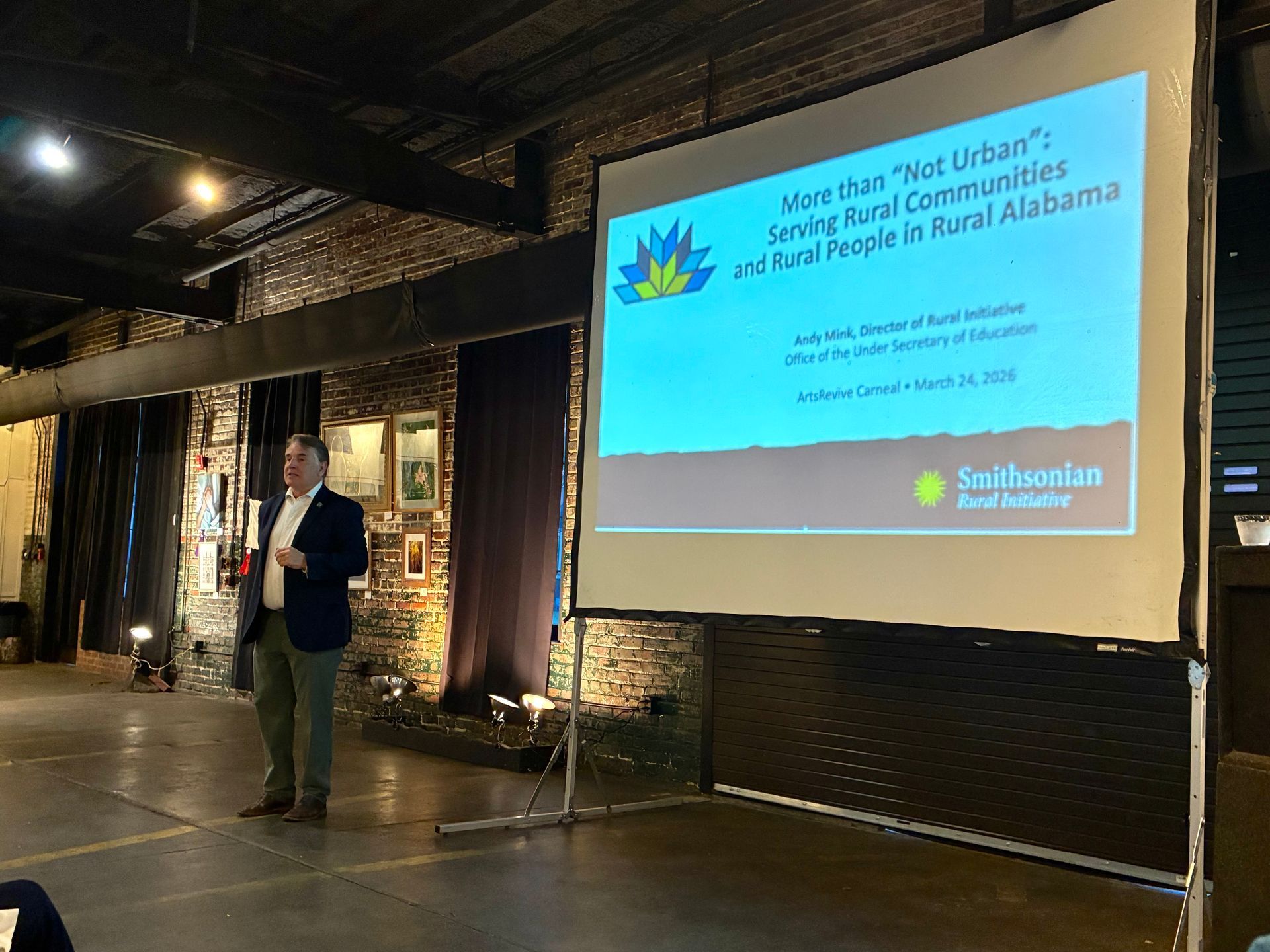
On Tuesday, March 24, the Smithsonian’s RI Director Andy Mink came to Selma to introduce the Smithsonian Rural Initiative to its residents and talk about the potential partnership in the community. | Selma and Dallas County Chamber of Commerce and Tourism Information
By Faith Callens
Special to the Selma and Dallas County Chamber of Commerce and Tourism Information
On Tuesday, March 24, Smithsonian’s Rural Initiative Director Andy Mink came to Selma on the behalf of Arts Revive Director Becky Youngblood to speak with residents and community partners about the Smithsonian Institution and its efforts toward rural communities.
Mink told the community that the presentation called “More than “Not Urban”: Serving People and Places in Rural Alabama” was for the city of Selma as whole, its citizens and its community leaders to sort of think about ways that the Smithsonian Institution in Washington, D.C. could really be an authentic partner.
Mink told the history of the Smithsonian Institution and its foundation to give the Selma community a closer look at what the institute is and what it stands for.
“So, the Smithsonian itself is nearly 180 years old,” Mink said. “It was founded with a gift from Britain. James Smithson gave his fortune to the United States to start the Smithsonian Institution, and his sole directions were to create an organization for the increase in diffusion of knowledge among men.”
Mink said the same ideology that Smithson had for the Smithsonian Institute nearly two centuries ago is the same ideology that is embedded in and deep rooted in the spirit of the Institution and its work as we know it today.
“One major misconception that I hear is that the Smithsonian is a single building, a single museum and that you come to Washington, D.C. and you walk into this single doorway and you have this singular experience in the U.S.,” Mink said. “But of course, the Smithsonian, instead, is a massive institution of 6,000 employees, of 21 museums of the National Zoo and 14 education and research centers. So, this facility itself is really globally known, recognized and massive. I say “massive” actually in the best possible use of that term right now and it is an organization with expertise in a wide variety. 7 million objects in our collection but only 1 percent are on the supply.”
Mink continued by saying, “That I’ve been told and I have heard from historians who work at the Smithsonian that that’s only about 15 percent of objects and artifacts that make up the American story and all the rest of them are sitting in shoe boxes underneath your bed.”
As Mink’s presentation went on, he showcased several artifacts and objects that the Smithsonian has to the public such as the desk that Thomas Jefferson carried until his death in 1825.
“Then Jefferson wrote the Declaration of Independence, then all of a sudden, this pile of wood becomes a much different shazam moment,” Mink said. “It becomes something that illustrates the birth of this country and of American Democracy and the ways that we imagine the community that we live in.”
Speaking of communities, Mink went from the exploration of artifacts and objects that you could see in the Institution in D.C. to a much tighter view of scope, speaking about the effect the Institute has on rural and small-town communities.
“We currently have three institutions in Alabama who are apart of our [ Smithsonian Affiliates Program],” Mink said. I think of it a little bit as a co-op, where you are a part of a membership, you have access to Smithsonian branding, Smithsonian resources, Smithsonian speakers and Smithsonian amplification.”
Mink then gave examples of how the Smithsonian can be in Huntsville, Birmingham and Anniston, Alabama and he also spoke about a popular program that the Institution has called MOMS (Museum on Main Street).
“For thirty some years, MOMS has been sending traveling exhibits to small towns all over the country that share exhibits that usually are six to 800 square feet. They are relatively small and my good friend Becky Nichols of the Selma and Dallas County Library hosted one of these in the past where the exhibit comes and spends maybe six weeks. There’s a big topic that all small towns can communicate around. It’s waterways, crossroads, its innovation and the idea isn’t necessarily to come and see an exhibit. The idea is to come and interact with the exhibit about where you are from, to be inspired, to talk to the people you are with about crossroads, that train you got stuck behind, to talk about innovation and the people that we are.”
Mink went on to talk about the Smithsonian’s digital footprint and how the three-year rural initiative program came into effect to help smaller communities.
“We receive about 30 million unique visitors every year,” Mink said. “These would be virtual speakers, webinars, instructional resources for teachers and different kinds of cohorts. We are always thinking of ways to expand our reach to the communities that we need to serve. But, this is where the rural initiative was initially conceived. This idea of being in every community and every classroom in America and how can the Smithsonian respond to the very unique characteristics of Rural America and not treat them as an afterthought and not sort of be unavailable because they are far away from Washington and the places that the Smithsonian sits."
So, you may wonder how does Selma fit?
Mink said through his presentation about the Smithsonian Rural Initiative and the examples provided through other smaller, rural cities that Selma could be a part of this initiative by first making the collaborative effort to work together with him and think about creative and meaningful ways to introduce the efforts of Smithsonian to Selma.
“Let’s just start working together,” Mink said. "Earn each other’s trust, develop, contribute show up, not disappear.” So, number one, there are ways [ we can work together through] our shovel ready programs and I have shared some of them where we can start working in service of Selma almost immediately, through the library, school systems, through Mrs. Pitts, working with Mrs. Becky Youngblood in various ways.”
Mink said there could be an arts and culture hub in Selma through the Smithsonian and through their shovel ready programs. He said they can immediately apply some of the things that they are doing in other smaller cities to Selma and become a part of its historic fabric.
Mink also said another way that the Smithsonian could be involved in the frameworks of Selma is by being included in our events such as the annual Bridge Crossing Jubilee, our local galas or just through the service of being a part of our programs that impact our youth, our public library and our rotary club.
“Would you like us to speak to them,” Mink told the crowd. “Would you like us to be a part of a brand application, not to bring money to us, but to amplify and improve your energy?
Mink said the last way that the institution could work with Selma is through one puzzling question of, “How can we make something up together and both bring our skills and our expertise in the development of making Selma better?
At the end of the presentation, Mink opened the floor for more questions about the Smithsonian and its rural initiative and brainstorming efforts from guests for the potential partnership in Selma.
For more information about the Smithsonian and its rural initiative, visit https://www.si.edu/education/rural-communities